

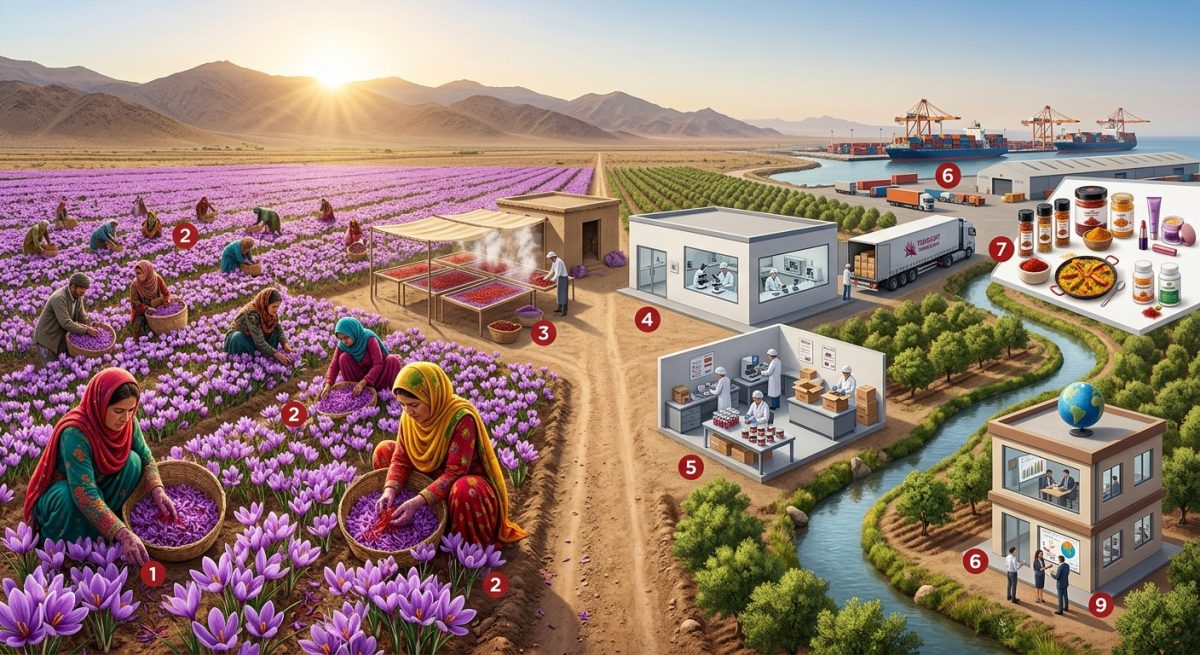
Saffron may begin with a small purple flower, but bringing it from the field to consumers around the world involves a complex network of people, processes and businesses.
From cultivation and harvesting to drying, processing, packaging, distribution and international trade, every stage can influence the final quality and value of saffron.
Understanding this value chain is essential for building a stronger, more transparent and sustainable global saffron industry.
1. Cultivation: Where the Journey Begins
Saffron comes from Crocus sativus, a flowering plant cultivated in specific climatic conditions.
Unlike many agricultural commodities, saffron production is highly labor-intensive. The flowers must be harvested during their flowering period, and the delicate stigmas are separated from the flowers by hand.
This makes agricultural knowledge and careful timing critical to the final product.
Producers therefore play one of the most important roles in the saffron value chain. Their decisions regarding planting material, cultivation practices, harvesting and post-harvest handling can have a direct effect on quality.
2. Harvesting: A Race Against Time
Saffron flowers have a relatively short flowering period.
During harvesting, flowers are carefully collected and the stigmas are separated. The stigmas must then be dried under appropriate conditions to preserve their valuable characteristics.
The process requires experience and attention to detail.
Poor handling at this stage can damage the product before it ever reaches a processor or trader.
3. Drying and Processing
Drying is one of the most important post-harvest stages.
The objective is to reduce moisture while preserving the characteristics that make saffron valuable, including its color, aroma and flavor-related compounds.
Different production regions have developed their own traditional practices for harvesting and processing saffron. Modern quality-control systems can complement these traditions by providing greater consistency and measurable quality.
Processing may also include cleaning, grading, sorting and preparation for different markets.
4. Quality Control
Once saffron leaves the farm, quality assurance becomes increasingly important.
Buyers and processors need to know what they are purchasing. Quality assessment can involve physical inspection, sensory evaluation, documentation and laboratory analysis.
For international trade, standardized approaches are particularly valuable because they allow products from different origins and suppliers to be evaluated against comparable criteria.
Quality control also helps protect the reputation of genuine saffron from adulterated or misrepresented products.
5. Packaging: Protecting Value
Saffron is a high-value product, so packaging is more than a marketing exercise.
Appropriate packaging helps protect the spice against moisture, light, heat and other environmental factors that can reduce quality.
Packaging also provides an opportunity to communicate essential information about the product, including origin, quantity, batch information and relevant certifications or quality claims.
For international markets, packaging and labeling must also take account of the requirements of the destination country.
6. Traders and International Markets
Traders connect producing regions with markets around the world.
Their role can include sourcing, quality evaluation, logistics, documentation, market development and establishing relationships between suppliers and buyers.
The international saffron market demonstrates how interconnected this industry has become.
For example, World Bank WITS trade data shows that Spain imported approximately $56.3 million worth of saffron in 2024, including more than $50.7 million from Iran.
This illustrates an important characteristic of the saffron trade: the country producing the saffron and the country processing, distributing or consuming it are not necessarily the same.
7. Processing Creates New Opportunities
Saffron is not limited to direct culinary use.
The industry includes applications across food, beverages, cosmetics, beauty products and other areas. The development of new applications can create additional value beyond the sale of raw saffron threads.
This is particularly important for producers and businesses seeking to move toward higher-value products.
Innovation can occur at many points in the value chain—from cultivation technology and processing methods to packaging, branding and product development.
8. Sustainability Across the Supply Chain
A sustainable saffron industry needs to consider more than agricultural production.
Environmental responsibility, efficient resource use, responsible harvesting, appropriate packaging, fair relationships and long-term economic viability all contribute to supply-chain sustainability.
Traditional agricultural knowledge can also play an important role.
Preserving valuable production practices while introducing appropriate technologies and quality systems can help the industry develop without losing the knowledge and cultural heritage associated with saffron cultivation.
9. The Importance of Collaboration
No single participant controls the entire saffron value chain.
Producers, researchers, processors, packagers, traders, regulators, technology companies and consumers all influence the development of the industry.
This makes collaboration particularly important.
Knowledge sharing can help producers improve cultivation and post-harvest practices. Traders can communicate changing market requirements. Researchers can develop new technologies and applications. Processors can create higher-value products. And industry organizations can help bring these stakeholders together.
Building a Stronger Global Saffron Industry
The future of saffron will depend on the ability of the industry to connect traditional knowledge with modern quality systems, technology, market intelligence and international cooperation.
A strong value chain is one in which every participant benefits from maintaining quality and integrity.
For producers, this can mean better market opportunities.
For traders and processors, it can mean greater consistency and trust.
For consumers, it means greater confidence in the products they purchase.
And for the saffron industry as a whole, it means protecting the value of one of the world’s most distinctive agricultural products.
The World Saffron Association works across this ecosystem, bringing together stakeholders involved in production, packaging, processing and trade while promoting knowledge exchange, quality, sustainability and international cooperation.
From a flower in the field to a product on a table thousands of kilometers away, saffron’s value is created at every stage of the journey.